





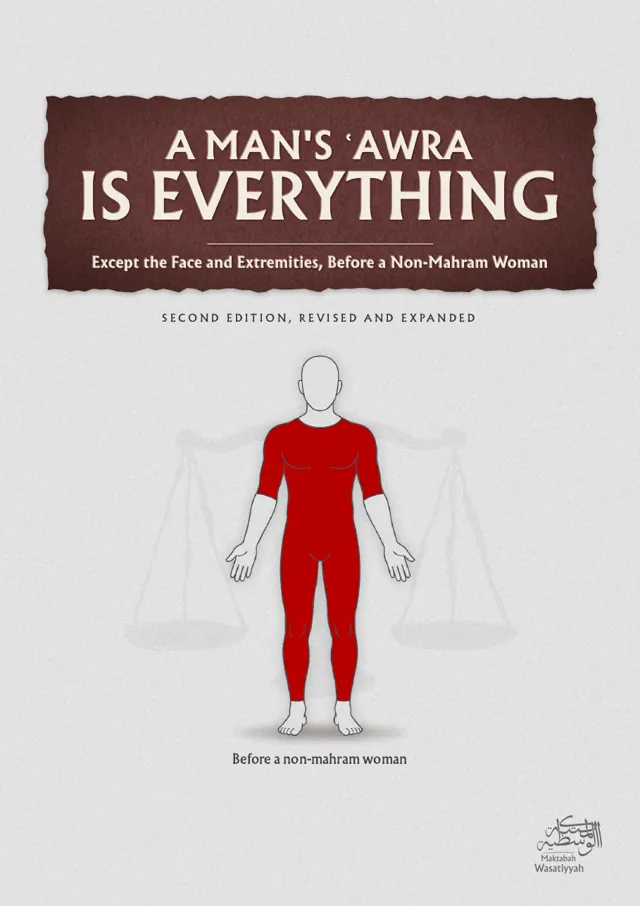
A Man's ʿAwra Is Everything
Except the Face and Extremities, Before a Non-Mahram Woman
7 November 2026 · 67 footnotes · pp. 3–23 · 25 min
Introduction
In the Name of Allah, the Most Merciful, the Especially Merciful.
All praise is due to Allah, who perfected the religion, completed His favor upon His servants, and made this noble Shariʿah a light by which the hearts are guided and the affairs of creation are set aright. He sent His Messenger ﷺ with guidance and the religion of truth, to make it prevail over all ways, even if the corrupters dislike it. May abundant peace and blessings be upon him, his family, his companions, and those who follow their path with excellence until the Day of Judgment.
To proceed: after the first edition of this booklet appeared, some said that its position was wrong and that its author was a mudallis. In their view, he had taken the words of the scholars out of context and hidden those who said otherwise. Several of them said this without having read the booklet to the end. The booklet does not hide the other view. It has a section of its own, in the words of the scholars who held it, and every quotation is given with its volume and page so that the reader can check it in the original.
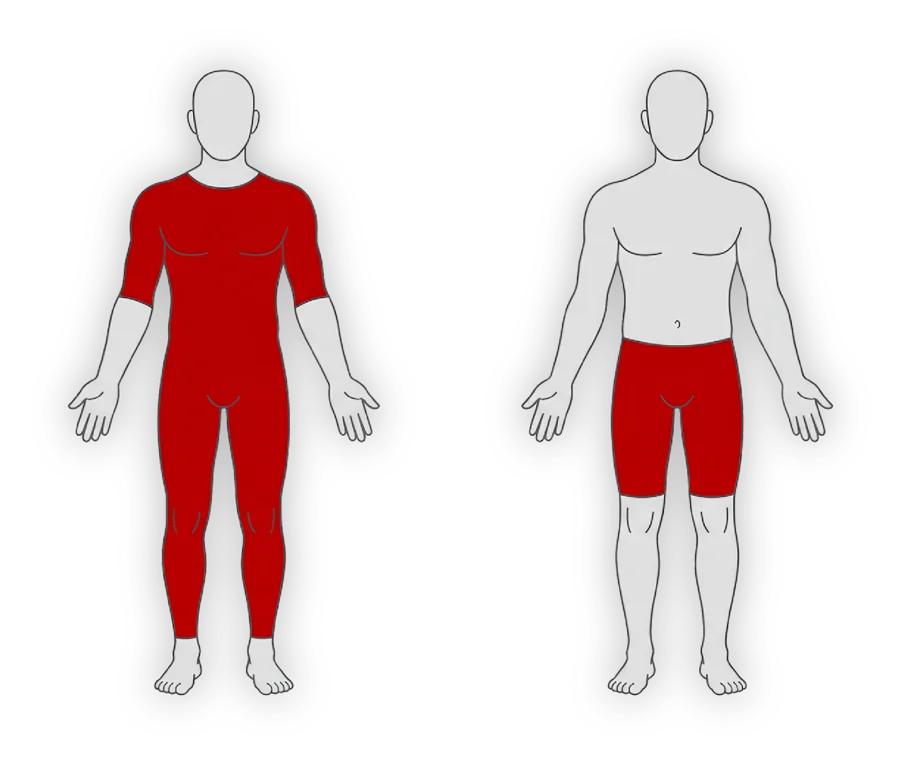
In short: in the relied-upon position of the Maliki school, a woman who is not his mahram may see of a man only his face and his extremities, that is, the head and neck, the forearms and hands, and the feet. The rest of his body is ʿawra before her, and he must cover it. Some commentators held that he only has to cover from the navel to the knee, but they too forbid her to look beyond his face and extremities.
Most of the texts quoted here belong to one chain of books. Khalil ibn Ishaq's al-Mukhtasar gives the positions of the school on which fatwa is given. Later scholars explained it in commentaries (sharh), and others wrote glosses (hashiya) on those commentaries. So when al-Dasuqi speaks of "the commentator", he means al-Dardir, whose commentary he is explaining.
Written by, ʿAli ʿAbd Allah al-Maliki
Founder of Maktabah Wasatiyyah
Germany
27 Jumada al-Ula 1448 AH, corresponding to 07/11/2026
A – The Ruling in the Words of the Scholars
1. The commentators on Khalil
Al-Dasuqi, the Egyptian glossator, explained al-Dardir's words "for a man, with another man or with his mahram" as follows:
(قوله: مع مثله أو مع محرمه) أي من النساء وأما عورته مع امرأة أجنبية سواء كانت حرة أو أمة فهي ما عدا الوجه والأطراف كما يأتي في قوله وترى من الأجنبي ما يراه من محرمه
"His words 'with another man or with his mahram': that is, [his mahram] women. As for his ʿawra with a non-mahram woman, whether free or a slave, it is everything except the face and the extremities, as comes in his words 'She may see of a non-mahram man what he may see of his mahram.'"1
Al-Dardir had written that a man's ʿawra is what is between the navel and the knee "with another man or with his mahram". Al-Dasuqi explains why these words were added: the navel-to-knee measure belongs to these two cases only. Before a non-mahram woman the measure is different, and he states it as the man's ʿawra, whether the woman is free or a slave.
On Khalil's line "She may see of a non-mahram man what he may see of his mahram", he said:
(قوله: وترى من الأجنبي ما يراه من محرمه) أي وحينئذ فعورة الرجل مع المرأة الأجنبية ما عدا الوجه والأطراف
"His words 'She may see of a non-mahram man what he may see of his mahram': that is, accordingly, a man's ʿawra with a non-mahram woman is everything except the face and the extremities."2
Here al-Dasuqi draws out what Khalil's wording implies. Khalil made a man's mahram women the measure of what a non-mahram woman may see of him. A man sees of his mother or sister only her face and extremities, so a non-mahram woman may see the same of him, and the rest of his body is his ʿawra before her.
He then explained that this line narrows down Khalil's earlier rule for men:
ثم إن قوله وترى من الأجنبي إلخ مقيد لقوله فيما تقدم وهي من رجل ما بين سرة وركبة أي إن عورة الرجل بالنسبة لغير المرأة الأجنبية بأن كان مع رجل مثله أو مع محرمه ما بين سرة وركبة أخذ مما ذكره هنا من أن عورته مع المرأة الأجنبية ما عدا الوجه والأطراف وقد أشار الشارح لذلك سابقا
"Moreover, his words 'She may see of a non-mahram man …' restrict his earlier words 'It is, for a man, what is between the navel and the knee.' That is, the man's ʿawra in relation to anyone other than a non-mahram woman, as when he is with another man or with his mahram, is what is between the navel and the knee. This is taken from what he says here, that his ʿawra with a non-mahram woman is everything except the face and the extremities, and the commentator [al-Dardir] indicated this earlier."3
This is the central passage. In Khalil's text the man's ʿawra is first given as navel to knee, with no condition. Al-Dasuqi explains that the later line on what a non-mahram woman may see restricts that first rule, so the navel-to-knee measure applies only before men and mahram women. He adds that al-Dardir had already pointed to this by writing "with another man or with his mahram". In the same gloss he says that she may not touch even his face and extremities, although she may look at them, unlike a mahram, who may touch what he may see.3
Al-Dardir, in his al-Sharh al-Saghir, named the parts she may not look at:
فلا يجوز لها أن تنظر لصدره ولا جنبه ولا ظهره ولا ساقه، ولو لم تخف لذة
"So it is not permitted for her to look at his chest, his side, his back or his shin, even if she does not fear pleasure."4
Al-Dardir does not leave the matter general. He names the chest, the side, the back and the shin, all of them outside the face and the extremities, and forbids her to look at them. The words "even if she does not fear pleasure" show that the ban does not depend on temptation. It holds in itself, as the ban on looking at the ʿawra does.
His student al-Sawi drew the conclusion in his gloss:
قوله: [ما يراه الرجل من محرمه] : فحينئذ عورة الرجل مع المرأة الأجنبية ما عدا الوجه والأطراف
"His words 'what a man sees of his mahram': so then the ʿawra of a man with a non-mahram woman is everything except the face and the extremities."5
Al-Sawi states the result in the language of ʿawra. If she may see of him only what a man sees of his mahram, then everything beyond the face and the extremities is ʿawra before her. He then explains that al-Dardir's list follows from the words "the face and the extremities", "as if he said: as for what is not of the extremities, it is forbidden."5
Al-Kharshi, the first Shaykh al-Azhar, said in his commentary on the same passage of Khalil:
وهي أي العورة الشاملة للمغلظة والمخففة من رجل مع غير أجنبية ما بين سرة وركبة وإنما قلنا مع غير أجنبية لما يأتي أن الأجنبية إنما ترى من الأجنبي الوجه والأطراف
"It, that is, the ʿawra, comprising both the major (mughallaza) and the minor (mukhaffafa), is, for a man with anyone other than a non-mahram woman, what is between the navel and the knee. We only said 'with anyone other than a non-mahram woman' because of what is coming: that a non-mahram woman may see of a non-mahram man only the face and the extremities."6
Al-Kharshi uses the school's two terms for what must be covered: the major ʿawra (mughallaza), whose exposure invalidates the prayer, and the minor ʿawra (mukhaffafa). He limits the navel-to-knee measure of both to men and mahram women, and says plainly that he added "with anyone other than a non-mahram woman" because of the rule on what she may see. He then answers an objection, that this passage concerns only the ʿawra in prayer: Khalil's words on a free woman with another woman show that the passage also defines the ʿawra that may not be seen.6
Al-ʿAdawi, al-Dardir's teacher, said in his gloss on al-Kharshi:
وأما مع المرأة فما عدا الوجه والأطراف فاختلف عورة الرجل مع مثله ومع المرأة هذا بالنسبة للرؤية وأما بالنسبة للصلاة فما بين السرة والركبة
"As for [his ʿawra] with a woman, it is everything except the face and the extremities. So the man's ʿawra with another man differs from his ʿawra with a woman. This is with respect to being seen; with respect to prayer, it is what is between the navel and the knee."7
Al-ʿAdawi separates the two settings in which the word ʿawra is used. In prayer, a man's ʿawra is from the navel to the knee. With respect to being seen, it depends on who sees him, and before a woman it is all but the face and the extremities.
And he summed up:
والحاصل أن عورة الرجل مع مثله أو مع امرأة محرم ما بين سرة وركبة وأما مع الأجنبية فما عدا الوجه والأطراف
"In sum: the ʿawra of a man with another man, or with a mahram woman, is what is between the navel and the knee; but with a non-mahram woman it is everything except the face and the extremities."7
His summary puts the non-mahram woman in the same sentence as the man and the mahram woman, as three cases of one ʿawra. He adds that a man may see more of a slave woman than she may see of him, and gives as the reason the strength of a woman's inclination towards men.7
Al-Nafrawi, a commentator on the Risala, explained the ʿawra with respect to being seen, which the Risala itself had not set out:
اعلم أن عورة الرجل الواجب عليه سترها عن الناس خلا زوجته وأمته ما بين الركبة والسرة مع رجل مثله أو امرأة محرم له … وأما عورته مع المرأة الأجنبية ولو أمة فهي ما عدا الوجه والأطراف
"Know that the ʿawra a man must cover from people, except his wife and his slave woman, is what is between the knee and the navel, when he is with another man or a mahram woman … As for his ʿawra with a non-mahram woman, even a slave, it is everything except the face and the extremities."8
Al-Nafrawi's wording matters. He does not speak only of what she may look at. He speaks of "the ʿawra a man must cover from people", and lists the cases under that heading: with men and mahram women it is from the navel to the knee, and with a non-mahram woman it is all but the face and the extremities. In the same passage he explains what it means for something to be ʿawra: of the thigh he says that "he must cover it, and it is forbidden for him to uncover it."8 Al-ʿAdawi said the same in his gloss on Kifayat al-Talib, and ended: "and she sees of a non-mahram man the face and the extremities only."9
Muhammad Illaysh, the Maliki mufti of Egypt, first separated the ʿawra in prayer from the ʿawra with respect to being seen, and then said:
وعورة الرجل بالنسبة للرؤية من رجل أو محرم ما بين سرته وركبته ومن أجنبية جميع بدنه إلا أطرافه
"The ʿawra of a man with respect to being seen: by a man or a mahram, it is what is between his navel and his knee; and by a non-mahram woman, it is his whole body except his extremities."10
Illaysh, one of the last great muftis of the school, gives the ruling in one sentence. He first explains that the ʿawra in prayer is one thing and the ʿawra with respect to being seen another, and then gives the second for each kind of viewer. Before men and mahram women it is from the navel to the knee; before a non-mahram woman it is his whole body except his extremities.
Al-Tataʾi reports that al-Basati, an early commentator, explained Khalil's line in the same way:
وقرره البساطي على أن عورة الرجل الأجنبي بالنسبة للمرأة غير عورتها بالنسبة له؛ فعورتها بالنسبة له ما عدا الوجه والكفين، كما تقدم، وعورته بالنسبة لها ما عدا الوجه والأطراف، كما أن عورتها محرمة بالنسبة له، كذلك هي. انتهى
"Al-Basati explained it as meaning that a non-mahram man's ʿawra in relation to a woman differs from her ʿawra in relation to him. Her ʿawra in relation to him is everything except the face and the hands, as already stated, and his ʿawra in relation to her is everything except the face and the extremities. Just as her ʿawra is forbidden in relation to him, so is his. End of quote."11
Al-Basati was a chief judge of Egypt and one of the earliest commentators on Khalil. He reads Khalil's line as a description of the man's ʿawra, set beside the woman's: her ʿawra before him is all but the face and the hands, and his ʿawra before her is all but the face and the extremities. His closing words, "so is his", put the two on the same footing.
2. The ruling applied
Ibn Abi Zayd al-Qayrawani, the author of the Risala, said: "A woman who dies on a journey, with no women and no mahram man with her: let a man perform dry ablution (tayammum) on her face and her hands. And if the dead person is a man, the women perform tayammum on his face and his arms up to the elbows, if there is no man with them to wash him and no woman from among his mahrams."12
Commenting on this, al-ʿAdawi said: "If it is asked: what is the difference between a man and a woman, such that she may perform tayammum for a non-mahram man up to his elbows, but he may not perform it for her up to her elbows, despite women's strong inclination towards men? The answer is the greater modesty of the woman compared with the man, and that women's inclination towards a man weakens once he is dead. Or [the answer is] that the ʿawra of a non-mahram man with a non-mahram woman is everything except the face and the extremities."13
Al-Nafrawi said: "If it is asked: what is the difference between a man and a woman, such that she may perform tayammum for a non-mahram man up to his elbows, while he may perform it for her only up to her wrists, despite women's strong inclination towards men? The answer is that the ʿawra of a non-mahram man with a non-mahram woman is everything except the face and the extremities, as we stated in the section on ʿawra. Also, there is the greater modesty of the woman compared with the man, especially since, once the man has died, [the inclination of] the woman towards him weakens."14
3. Later works
Mayyara of Fez said: "As for [his ʿawra] in relation to women: a non-mahram woman may see of a man his face and his extremities."15 Al-Wadani of Mauritania said: "She sees of a non-mahram man what a man sees of his mahram, which is the extremities and the face."16
Kawkab ʿUbayd, a modern author, said: "Its limit [that is, of the man's ʿawra] before a non-mahram woman: his whole body, with the head, the arms and the feet excepted."17
Al-Jaziri, comparing the four schools, said: "The Malikis and the Shafiʿis said: a man's ʿawra outside prayer differs according to who is looking at him. In relation to his mahram women and to men, it is what is between his navel and his knee; in relation to a non-mahram woman, it is his whole body, except that the Malikis excluded the face and the extremities, namely the head, the arms and the feet, which a non-mahram woman may look at when she is safe from taking pleasure [in it]; otherwise it is forbidden."18
The Kuwaiti Fiqh Encyclopedia, under the man's ʿawra and citing al-Dasuqi, gives the Maliki position as "the face and the extremities, when safe from temptation."19
B – The Basis of the Ruling
1. The text of the Mudawwana
The root of the ruling is a text of Malik in the Mudawwana, in the chapter on washing the dead:
قال وقال مالك إذا مات الرجل مع النساء وليس معهن رجل ولا منهن ذات محرم منه تغسله، يممنه بالصعيد فيمسحن بوجهه ويديه إلى المرفقين … قال: وكذلك المرأة تموت مع الرجال إلا أن الرجال لا ييممون المرأة إلا على الكوعين فقط، ولا يبلغوا بها إلى المرفقين
"He said: Malik said: If a man dies among women, with no man among them and no woman who is his mahram to wash him, they perform tayammum for him with clean earth: they wipe his face and his hands up to the elbows. … He said: The same applies to a woman who dies among men, except that the men perform tayammum for the woman only up to the wrists, and do not take it up to the elbows."20
In tayammum, the one who performs it sees and wipes the face and the arms. Malik allowed the women to go up to the elbows for a man, but the men only to the wrists for a woman. The difference only makes sense if a woman may see more of a man than he may see of her, namely what a man sees of his mahram women. Al-Qadi ʿIyad of Ceuta reports that this text "is used as proof by those who hold that a woman may see of a non-mahram man only what a man sees of his mahram women."21 Al-Rajraji called the elbows "the explicit text of the Mudawwana", and said the disagreement over how far the tayammum goes comes from the disagreement over what she may see of him.22 Ibn ʿArafa repeated the ruling,23 and Bahram, al-Tataʾi and al-Dardir all give the elbows as the well-known (mashhur) position, mentioning the wrists only as a weaker view.24
2. The text of Khalil
Khalil said: "It [the ʿawra] is, for a man, a slave woman (even one with some element of freedom), and a free woman in front of another woman: what is between the navel and the knee. [For a free woman] in front of a non-mahram man: everything other than the face and the hands … In front of a mahram: everything other than the face and the extremities. She may see of a non-mahram man what he may see of his mahram, and of her mahram what a man may see of another man."25
In al-Tawdih, his commentary on Ibn al-Hajib, written before the Mukhtasar, Khalil gave the same measure and quoted Ibn Rushd against the strict view: "It has also been said: it is like the ruling on what he sees of her. He said: That is far-fetched. He said: It would follow from it that women perform tayammum for non-mahram men only up to the wrist, and that is found in none of its rulings."26
Ibn Rushd's argument rests on the Mudawwana. If a woman could see of a man only what he may see of her, the women could not take the tayammum beyond his wrists. Since the Mudawwana lets them go up to the elbows, the strict view does not fit the school's own rulings.
Bahram al-Damiri, Khalil's student, said: "That is, a free woman may look at the face and the extremities of a non-mahram man, because that is what a mahram man sees of his mahram women, since it is not ʿawra in relation to him."27
Khalil first gives the man's ʿawra as navel to knee without exception. Then, for the non-mahram woman, he switches from defining the ʿawra to "she may see" (wa-tara). That change of wording is the root of the other reading in section D. His measure is the mahram women: as a man sees of his mother only her face and extremities, so a non-mahram woman sees of a man the same parts, and no more.
3. The narrations from Malik
Ibn al-Qattan of Fez said: "It is reported that Malik said: 'The wife's maidservant may not see the husband's thigh, and neither his wife's maidservant, nor his son's, nor his father's may come in to him in the privy.' This is because he is not their owner, so it is not permitted for him to uncover himself before them; they are non-mahram women to him, so they may not see him."28 The reason he gives concerns the man himself, not only the women's gaze.
4. Ibn Rushd's explanation
Ibn Rushd al-Jadd, the judge of Cordoba, said that Malik was lenient about a eunuch slave seeing a man's uncovered thigh, "because it has been reported that the thigh is not ʿawra," and then said: "As for the wife's maidservant seeing the man's thigh uncovered, the prohibition of that is clear, because the ruling on a woman looking at a non-mahram man is the same as the ruling on a man looking at his mahram women. The proof of this is that the Prophet ﷺ permitted Fatima bint Qays to spend her waiting period with the blind Ibn Umm Maktum; and a man may not look at his mother's thigh."29
In his discussion of women entering the bathhouse, he put the question in terms of the ʿawra itself:
لأن بدن المرأة إنما عورة على الرجل لا على المرأة. وإنما اختلف في بدن الرجل هل هو عورة على المرأة، فقيل: إنه لا يجوز للمرأة أن تنظر من الرجل إلا إلى ما يجوز للرجل أن ينظر إليه من المرأة. والصحيح أنه يجوز للمرأة أن تنظر من الرجل إلى ما يجوز للرجل أن ينظر إليه من ذوات محارمه
"For the body of a woman is ʿawra only for a man, not for a woman. The disagreement concerns only the body of a man: is it ʿawra for a woman? It was said that a woman may look at nothing of a man except what a man may look at of a woman. The correct view is that a woman may look at those parts of a man that a man may look at of his mahram women."30
Ibn Rushd first notes that a woman's body is ʿawra only in relation to men. He then asks whether a man's body is ʿawra in relation to a woman, and answers that she may see of him what he may see of his mahram women. Both the question and the answer are put in terms of ʿawra.
He gave as proof the words of the Prophet ﷺ to Fatima bint Qays: "Spend your waiting period at Ibn Umm Maktum's, for he is a blind man; you can lay aside your garments."31 "Were it not that her looking at him takes the ruling of a man looking at his mahram women, the Prophet ﷺ would not have permitted her to spend her waiting period with him. This is clear, and Allah knows best."30 Al-Hattab of Mecca quotes the same passage from Ibn Rushd on Khalil's line.32 In al-Muqaddimat, at the end of his chapter on covering the ʿawra, he again called this measure "the correct one".33
C – The Face and the Extremities
1. What the extremities are
The commentators define the extremities for a woman before her mahram, and the same definition applies here, because Khalil made a woman's mahram the measure; hence "her" in several texts.
Al-Dasuqi said: "His words 'and her extremities': that is, and other than her extremities, which are the forearms, the feet, the neck and the head."34 Illaysh said: "the neck, the head, the forearm and the foot; not the back, the chest, the breast or the shin."35
Al-Dardir said they are "the head, the arms and the feet." By "the arms" (al-yadayn) he means the hands and forearms, and by "the feet" (al-rijlayn) the feet, not the legs, since he goes on to forbid her to look at his chest, side, back or shin.36
Al-Qadi ʿIyad, as al-Hattab quotes him, excepted only "the forearms" and "what is above the upper chest." Al-Basati, also as al-Hattab quotes him, listed the face, the ends of the feet, the wrists, the hair "and the like."37 Al-Tataʾi said: "such as the feet, the wrists, the hair of the head and the like."38 Al-Nafrawi's teacher said, as al-Nafrawi quotes him: "such as her head, her forearms, and what is above her upper chest."39
Al-Zurqani included the arm "from the shoulder." Al-Bannani said: "Rather, the forearm is from the elbow; as for the upper arm up to the shoulder, it is forbidden."40
So the extremities are the head with the hair and neck, the forearms and hands, and the feet; not the shoulders, upper arms, chest, back, sides or shins.
2. The shoulders
The shoulders are not among the extremities, so a non-mahram woman may not look at them, and on the relied-upon reading they are part of the ʿawra he must cover before her. Al-Bannani above already excluded the upper arm up to the shoulder, and al-Dardir excluded the back. In the parallel case of a woman in prayer, al-Zurqani treated the shoulder like the chest. Al-Majlisi, the Mauritanian commentator, said: "Likewise her shoulder, for it is like her chest, as appears to be the case. Shaykh ʿAbd al-Baqi [al-Zurqani] said this."41
Ahmad Zarruq of Fez said in his commentary on the Risala: "A woman with another woman is like a man with another man, even if she is from the People of the Book, according to the well-known view; with a mahram, [her ʿawra is] everything other than the face and the extremities; and she may see of a non-mahram man what he may see of his mahram."42 In al-Nasiha al-Kafiya he said that a man of muruʾa may not uncover his head unless that is the custom of his land, and then: "As for uncovering the shoulders and the like, [it is not permitted] absolutely, except out of necessity."43
Zarruq's ruling fits this: the head is among the extremities, so uncovering it is left to muruʾa and custom, while the shoulders are outside them, so uncovering them is not permitted. Zarruq does not, however, state this link himself.
D – The Other Reading
Some commentators on Khalil held that this ruling only limits her gaze, so that he is obliged to cover only what is between the navel and the knee. Both sides agree that she may see of him only the face and the extremities.
1. Its proponents
Al-Zurqani said Khalil's line does not restrict the earlier ruling that a man's ʿawra is from the navel to the knee, "because what they convey is different."44
Al-Bannani said of the ruling in section A: "the correct view is the opposite."45 Explaining al-Zurqani's reason, al-Bannani said: "That is, because what is meant here is to explain what she may look at of a non-mahram man and what she may not. It does not follow that this is ʿawra on his part, because he is not obliged to cover it. Al-Rammasi said: this is the only tenable reading. As for restricting the earlier ruling by this one, that is not correct."44
Al-Majlisi said: "This is explicit that the man is not obliged to cover his shins, or what is above his navel, from a non-mahram woman, just as [he is not obliged to cover] his knees and navel. But she herself may not see anything of him except the face and the extremities." And: "So the man is obliged to cover only what is between the navel and the knee, and it is forbidden for the woman to look at anything of him except his face and extremities."46
Al-Amir, author of al-Majmuʿ, said: "It, that is, the ʿawra, with respect to being seen … for a man with another man and with his mahram, is from the navel to the knee … and with a non-mahram woman, even a slave, it is everything other than the face and the extremities, so he sees more of her than she sees of him." But in a note of his own on the same passage, which is printed in the gloss, he said that although she may not look at what is beyond the extremities, the man "is not obliged to cover it; it is only forbidden for her to look at him."47
Al-Dasuqi himself reported this reading: "Some said it does not restrict it, because the two concern different topics: the earlier one is about ʿawra, and this one is about looking."48
2. Why the ruling of section A is the relied-upon one
This other reading rests on Khalil's change of wording from "it is" to "she may see". Even so, the ruling stated in section A is the stronger and the relied-upon (muʿtamad) position of the school, for five reasons.
First, most of the commentators hold it: al-Basati, al-Kharshi, al-ʿAdawi, al-Nafrawi, al-Dasuqi, al-Sawi and Illaysh, and al-Dasuqi says al-Dardir indicated it.
Second, al-Dasuqi knew the other reading. He mentions it only as "some said" and does not follow it. In his own explanation, Khalil's words "she may see" narrow down the earlier rule of navel to knee, so that rule applies only before men and mahram women.
Third, the scholars speak of what he must cover, not only of where she may look. Al-Nafrawi lists the non-mahram woman under "the ʿawra a man must cover from people"; al-Kharshi limits both the major and the minor ʿawra by her; and al-Basati says "so is his [ʿawra]."
Fourth, in the usage of the school, ʿawra is what must be covered for its own sake, not only when temptation is feared. Khalil drew this line himself:
واعلم أنه إذا خشي من الأمة الفتنة وجب الستر لدفع الفتنة لا لأنه عورة
"Know that if temptation is feared from a slave woman, covering becomes obligatory in order to ward off the temptation, not because it is ʿawra."49
Illaysh said the same:
وإن خيف من رؤية ما زاد على ما بين السرة والركبة من أمة فتنة حرمت رؤيته لخوف الفتنة لا لأنه عورة وكذا وجه الحرة وكفاها والعورة نظرها محرم ولو لم تخش فتنة
"If temptation is feared from seeing what is beyond the navel and knee of a slave woman, seeing it is forbidden because of the fear of temptation, not because it is ʿawra, and likewise the face and hands of a free woman. Whereas looking at the ʿawra is forbidden even when no temptation is feared."50
So when al-Dasuqi, al-Sawi, al-Nafrawi and Illaysh call the rest of a man's body ʿawra before a non-mahram woman, they are not describing a gaze she avoids for fear of temptation, but a part he must cover. Al-Dardir's words point the same way: she may not look at his chest, side, back or shin "even if she does not fear pleasure." Even al-Bannani, who held the other reading, wrote elsewhere that "the ʿawra of looking has no meaning except that uncovering it is forbidden."51 And the school's rule on means applies here: al-Qarafi said that "the means to what is forbidden is forbidden," and uncovering before her is the means to a gaze that is forbidden to her.52
Fifth, Ibn Rushd frames the question as whether "the body of a man is ʿawra for a woman," and later works and the Kuwaiti Encyclopedia also call it ʿawra.
On both readings, she may not look beyond his face and extremities.
E – Other Views within the School
Sections A to D dealt with what a man must cover. This section deals with a related question: how much of a non-mahram man may a woman look at? Three views are recorded in the school. On all three, looking with desire, or where temptation is feared, is forbidden; they differ only on what she may look at when there is neither.53
1. The lenient view
She may look at all of him except what is between the navel and the knee, just as one man may look at another.54
2. The middle view
She may look at what a man may look at of his own mahram women, such as his mother or sister: the face and the extremities. His chest, back, upper arms, thighs and shins are closed to her. This is the relied-upon position and the ruling of this booklet.55
3. The strict view
She may look at no more of him than he may look at of her, that is, only his face and hands.56
F – Muruʾa
1. What muruʾa is
Even what is not ʿawra is subject to propriety (muruʾa). Al-Dardir defined it as "the perfection of the self by guarding it from whatever brings it blame by custom, even if it is outwardly permissible, such as eating in the market for someone who is not of the market's people."57 Ibn ʿArafa defined it as keeping to those permissible things whose omission brings blame by custom, and keeping away from those permissible things whose doing brings blame by custom. As examples he gave a well-off man who does not wear sandals in a land where walking barefoot is considered ugly for someone like him, and eating in the market.58
So muruʾa concerns things that are permissible in themselves. What makes them blameworthy is custom: how people of standing in a given place regard them.
2. Its ruling
Muruʾa is not a mere matter of manners. Al-Sawi explains why the jurists made it a condition of probity: "because whoever adopts what does not befit him, even if it is not forbidden, is drawn by it into not guarding his religion and into following desires."59 Ibn ʿArafa said that the narrations and statements make clear that abandoning muruʾa is a defect in a person's probity, because it shows a lack of care for his religion. Al-Tunisi said that being characterised by muruʾa "is required, and its opposite is forbidden, even if at first sight it appears permissible."60 Ibn al-Qattan said: "Preserving muruʾa is prescribed in the Shariʿah, and abandoning it may impugn the probity of an upright man."61
3. Muruʾa and what a man shows
Ibn al-Qattan applied this directly to uncovering the body. Of the parts a man may show without sin, he said: "Some of what we said may definitely be shown, without sin in uncovering it, is a matter of muruʾa, and that depends on persons and customs. For a great man, such as the ruler, the scholar and people of distinction, to show any of it is not like craftsmen and laborers showing it … Allah the Exalted has commanded us to take our adornment, and whoever is accustomed to wearing a turban and goes out bareheaded, for example, without necessity, has gone against what he was commanded."61
On the thigh, he reports that even those who do not count it ʿawra say that a man "does not sin by showing it, but showing it is not part of muruʾa." He himself held it to be ʿawra and added: "It is established with certainty in the Shariʿah that the preservation of muruʾa must be observed, and there is no muruʾa in uncovering that and treating it lightly."62
Ahmad Zarruq put the same rule plainly: "It is not permitted for a man of muruʾa to uncover his head, nor to walk barefoot, unless it is a custom in his land that is not considered ugly. As for uncovering the shoulders and the like, [it is not permitted] absolutely, except out of necessity."63 Al-Shatibi gave uncovering the head as his example of a custom that changes from place to place: "For people of muruʾa it is ugly in the lands of the East, and not ugly in the lands of the West. So the legal ruling differs with this difference: among the people of the East it impugns probity, and among the people of the West it does not."64
So the head, though it is one of the extremities, is left to custom. Zarruq makes no such allowance for the shoulders.
4. Muruʾa before Allah
Malik reported that Ibn ʿUmar saw his freedman Nafiʿ praying alone in a single garment and asked him: "Would you go out to the market in one garment?" Nafiʿ said: "No." Ibn ʿUmar said: "Then Allah is more deserving that one should make oneself presentable for Him."65 What a man would not do before people of standing, he should not do before his Lord.
5. Modesty
Behind muruʾa stands modesty. Al-Baji explained the hadith "Modesty is part of faith" as meaning that it is one of the laws of faith,66 and al-Zurqani said that modesty is what prevails among the people of Islam, "because it completes the noble character traits which he ﷺ was sent to perfect."67
So on every reading, a man who goes about in public with his shoulders, chest or back bare breaches muruʾa wherever custom considers it improper, and more so a scholar or a man of standing. Those who hold the other reading, that he need only cover from the navel to the knee, are still bound by this.
In Sum
- A non-mahram woman may see of a man only his face and extremities, when safe from temptation.
- The extremities are the head with the hair and neck, the forearms and hands, and the feet.
- The relied-upon position is that the rest is his ʿawra before her, which he must cover.
- On every reading, muruʾa governs what he shows in public.
And Allah is the One who truly has the Knowledge
and may Allah send His blessings on Muhammad
and his family and companions.
[End of Booklet]
Bibliography
Maliki Works
- Malik ibn Anas, al-Mudawwana. Ed. Dar al-Kutub al-ʿIlmiyya. shamela.ws/book/587: 1/261
- Ibn Abi Zayd al-Qayrawani, al-Risala. Ed. Dar al-Fikr. shamela.ws/book/11373: p. 53
- Al-Baji, al-Muntaqa Sharh al-Muwattaʾ. Ed. Matbaʿat al-Saʿada. shamela.ws/book/6684: 7/214
- Ibn Rushd al-Jadd, al-Bayan wa-l-Tahsil. Ed. Dar al-Gharb al-Islami. shamela.ws/book/21751: 4/288, 17/368, 17/491, 18/550; al-Muqaddimat al-Mumahhidat. Ed. Dar al-Gharb al-Islami. shamela.ws/book/21735: 1/185, 3/437
- Ibn al-ʿArabi, Ahkam al-Qurʾan. Ed. Dar al-Kutub al-ʿIlmiyya. shamela.ws/book/1464: 3/380
- Al-Qadi ʿIyad, al-Tanbihat al-Mustanbata. Ed. Dar Ibn Hazm. shamela.ws/book/14253: 1/288
- Ibn al-Qattan al-Fasi, Ihkam al-Nazar fi Ahkam al-Nazar. Ed. Dar al-Qalam. shamela.ws/book/17442: p. 132, p. 133, p. 151, p. 156, p. 430, p. 434
- Al-Rajraji, Manahij al-Tahsil. Ed. Dar Ibn Hazm. shamela.ws/book/123685: 2/40
- Al-Qarafi, al-Dhakhira. Ed. Dar al-Gharb al-Islami. shamela.ws/book/1717: 1/153
- Khalil ibn Ishaq, al-Tawdih fi Sharh Mukhtasar Ibn al-Hajib. Ed. Markaz Najibawayh. shamela.ws/book/14442: 1/301, 1/302; Mukhtasar Khalil. Ed. Dar al-Hadith, Cairo. shamela.ws/book/11355: p. 30
- Al-Shatibi, al-Muwafaqat. Ed. Dar Ibn ʿAffan. shamela.ws/book/11435: 2/489
- Ibn ʿArafa, al-Mukhtasar al-Fiqhi. Ed. Muʾassasat Khalaf Ahmad al-Khabtur. shamela.ws/book/16968: 1/436, 9/245
- Bahram al-Damiri, Tahbir al-Mukhtasar. Ed. Markaz Najibawayh. shamela.ws/book/147313: 1/264, 1/565
- Al-Mawwaq, al-Taj wa-l-Iklil li-Mukhtasar Khalil. Ed. Dar al-Kutub al-ʿIlmiyya. shamela.ws/book/21611: 2/183
- Ahmad Zarruq, Sharh Zarruq ʿala Matn al-Risala. Ed. Dar al-Kutub al-ʿIlmiyya. shamela.ws/book/14556: 1/131, 1/132; al-Nasiha al-Kafiya li-man Khassahu Allah bi-l-ʿAfiya. shamela.ws/book/258: p. 11
- Al-Tataʾi, Jawahir al-Durar fi Hall Alfaz al-Mukhtasar. Ed. Dar Ibn Hazm. shamela.ws/book/150676: 2/24, 2/521
- Al-Hattab, Mawahib al-Jalil fi Sharh Mukhtasar Khalil. Ed. Dar al-Fikr. shamela.ws/book/569: 1/500, 1/501
- Mayyara, al-Durr al-Thamin wa-l-Mawrid al-Muʿin. Ed. Dar al-Hadith, Cairo. shamela.ws/book/14249: p. 260
- Al-Zurqani, Sharh al-Zurqani ʿala Mukhtasar Khalil, with Hashiyat al-Bannani. Ed. Dar al-Kutub al-ʿIlmiyya. shamela.ws/book/14297: 1/312, 1/315, 1/316
- Al-Kharshi, Sharh Mukhtasar Khalil, with Hashiyat al-ʿAdawi. Ed. al-Matbaʿa al-Kubra al-Amiriyya. shamela.ws/book/91: 1/246, 1/247
- Muhammad al-Zurqani, Sharh al-Zurqani ʿala Muwattaʾ al-Imam Malik. Ed. Maktabat al-Thaqafa al-Diniyya. shamela.ws/book/551: 4/406
- Al-Nafrawi, al-Fawakih al-Dawani. Ed. Dar al-Fikr. shamela.ws/book/21589: 1/130, 1/288
- Al-ʿAdawi, Hashiyat al-ʿAdawi ʿala Kifayat al-Talib al-Rabbani. Ed. Dar al-Fikr. shamela.ws/book/21597: 1/170, 1/171, 1/414
- Al-Dardir, al-Sharh al-Saghir, with al-Sawi's Bulghat al-Salik. Ed. Dar al-Maʿarif. shamela.ws/book/21607: 1/290, 4/240
- Al-Dasuqi, Hashiyat al-Dasuqi ʿala al-Sharh al-Kabir. Ed. Dar al-Fikr. shamela.ws/book/21604: 1/213, 1/215, 1/410
- Muhammad al-Amir, Dawʾ al-Shumuʿ Sharh al-Majmuʿ. Ed. Dar Yusuf ibn Tashfin. shamela.ws/book/32195: 1/325, 1/326
- Muhammad Illaysh, Minah al-Jalil Sharh Mukhtasar Khalil. Ed. Dar al-Fikr. shamela.ws/book/21614: 1/221, 1/222, 8/394
- Al-Majlisi, Lawamiʿ al-Durar fi Hatk Astar al-Mukhtasar. Ed. Dar al-Ridwan, Nouakchott. shamela.ws/book/149697: 2/6, 2/10, 2/14
- Al-Wadani, Mawhub al-Jalil fi Sharh Mukhtasar Khalil. Ed. Maktabat al-Qarnayn, Nouakchott. shamela.ws/book/30174: 1/238
Hadith Collections
- Muslim, Sahih Muslim. Ed. Dar Ihyaʾ al-Turath al-ʿArabi. shamela.ws/book/1727: 2/1114
Contemporary Works
- Al-Jaziri, al-Fiqh ʿala al-Madhahib al-Arbaʿa. Ed. Dar al-Kutub al-ʿIlmiyya. shamela.ws/book/9849: 1/175
- Kawkab ʿUbayd, Fiqh al-ʿIbadat ʿala al-Madhhab al-Maliki. Ed. Matbaʿat al-Inshaʾ. shamela.ws/book/12978: p.143
- al-Mawsuʿa al-Fiqhiyya al-Kuwaytiyya. Ed. Wizarat al-Awqaf, Kuwait. shamela.ws/book/11430: 31/51
This publication is a waqf, a charitable endowment made for the sake of Allah and for the benefit of all Muslims. It is not to be sold, traded, or used for worldly gain. Whoever wishes to print, copy, or distribute it free of charge may do so, provided that it is reproduced in full and without any alteration to the original text. Translations into other languages are permitted, provided that they are faithful to the original and name it as their source. First published in 2026. Second edition, revised and expanded, 1448 AH / 2026. Published by Maktabah Wasatiyyah.
Image credits. Paintings by Jules Laurens (1848), Josep Tapiró i Baró and Franz Xaver Kosler. All works are in the public domain.