





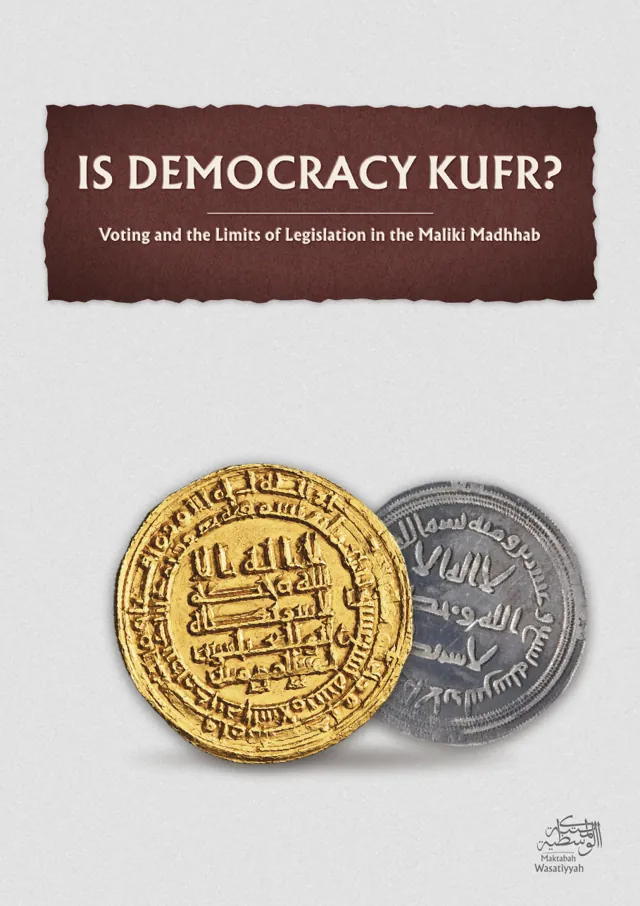
Is Democracy Kufr?
Voting and the Limits of Legislation in the Maliki Madhhab
6 November 2026 · 17 footnotes · pp. 3–9 · 9 min
Introduction
In the Name of Allah, the Most Merciful, the Especially Merciful.
All praise is due to Allah, the Judge of judges, to whom belongs the creation and the command. May peace and blessings be upon His Messenger Muhammad ﷺ, who consulted his Companions in their affairs, and upon his family and Companions, the Rightly Guided Caliphs who ruled by justice and shura.
To proceed: whether democracy is permissible, or whether it amounts to kufr, is among the most frequently asked questions among Muslims today, particularly among those living in the West. The question is usually answered in one of two ways. Some hold that democracy is kufr in itself, that parliaments are a form of shirk, and that whoever votes has left Islam. Others accept democracy without reservation, as though the people were free to decide any matter and every voice carried equal weight. Ibn Farhun had already described two corresponding errors in his own time: that of those who held the Sharia to be incapable of governing public affairs, and that of those who overstepped its limits in the name of governance.1
Both answers pass over the distinctions on which the ruling depends. The present booklet therefore examines three questions on the basis of the classical sources. First, in what sense democracy would constitute kufr, and in what sense it would not. Second, who, according to the jurists, is entitled to choose the ruler: the people of authority, or the whole population, including those who lack knowledge. Third, which matters may be decided and revised by vote, and which lie beyond the reach of any vote because Allah has already decided them.
The treatment draws principally on the Maliki school, in particular al-Qurtubi, Ibn al-Arabi, al-Shatibi, al-Qarafi, Ibn Farhun, Ibn Khaldun and Ibn Ashur, and is supplemented by al-Mawardi and Ibn Taymiyya, whose works on governance are cited across the schools. Every quotation is referenced to its page in the footnotes and in the Bibliography.
Written by, ʿAli ʿAbd Allah al-Maliki
Founder of Maktabah Wasatiyyah
Germany
26 Jumada al-Ula 1448 AH, corresponding to 06/11/2026
A – The Criterion of Kufr
The term democracy may denote either a doctrine or a procedure, and the ruling differs accordingly. Allah says of the People of the Book: "They have taken their rabbis and monks as lords besides Allah" (9:31). Hudhayfa explained the nature of this lordship:
هل عبدوهم؟ فقال لا، ولكن أحلوا لهم الحرام فاستحلوه، وحرموا عليهم الحلال فحرموه.
Did they worship them? He said: "No. But they made the forbidden lawful for them, and they took it as lawful; and they made the lawful forbidden for them, and they took it as forbidden."2
If democracy is understood as the doctrine that the people possess the right to make lawful what Allah has forbidden, and that their will takes precedence over revelation, then this belief is kufr and must be rejected. Ibn al-Arabi defines the boundary in his commentary on "Whoever does not judge by what Allah has revealed, those are the kafirs" (5:44):
قال طاوس وغيره: ليس بكفر ينقل عن الملة، ولكنه كفر دون كفر. وهذا يختلف إن حكم بما عنده على أنه من عند الله؛ فهو تبديل له يوجب الكفر، وإن حكم به هوى ومعصية فهو ذنب تدركه المغفرة على أصل أهل السنة في الغفران للمذنبين.
Tawus and others said: it is not a kufr that takes one out of the religion, but a kufr below kufr. This differs: if he rules by what he has of his own, claiming that it is from Allah, that is a changing of [Allah's law], which entails kufr. But if he rules by it out of desire and disobedience, it is a sin that forgiveness can reach, according to the principle of Ahl al-Sunna that sinners can be forgiven.3
If, however, democracy is understood as a procedure for selecting rulers, holding them to account and limiting their power, by means of consultation and assemblies that decide worldly matters, then it is a means, and means take the ruling of the ends they serve. Whether such a procedure is lawful therefore depends on two further questions: who takes part in the choice, and what is submitted to it. These are examined in the following two sections.
B – Who Chooses: The People of Authority or the General Public?
Modern democracy rests on the principle that every adult citizen has an equal vote. The classical jurists, by contrast, did not assign the choice of the ruler to the population as a whole, but to a defined group, the people of authority (ahl al-hall wa-l-aqd), and they laid down conditions for membership of it. Al-Mawardi states:
فإذا ثبت وجوب الإمامة ففرضها على الكفاية كالجهاد وطلب العلم … وإن لم يقم بها أحد خرج من الناس فريقان: أحدهما: أهل الاختيار حتى يختاروا إماما للأمة. والثاني: أهل الإمامة حتى ينتصب أحدهم للإمامة، وليس على من عدا هذين الفريقين من الأمة في تأخير الإمامة حرج ولا مأثم … فأما أهل الاختيار فالشروط المعتبرة فيهم ثلاثة: أحدها: العدالة الجامعة لشروطها. والثاني: العلم الذي يتوصل به إلى معرفة من يستحق الإمامة على الشروط المعتبرة فيها. والثالث: الرأي والحكمة المؤديان إلى اختيار من هو للإمامة أصلح، وبتدبير المصالح أقوم وأعرف
Once the obligation of the imama is established, it is a communal obligation, like jihad and seeking knowledge. … If no one undertakes it, two groups are singled out from the people. The first is the people of choice, until they choose a ruler for the community. The second is the people eligible for the imama, until one of them is put forward for it. For the rest of the community there is no blame and no sin in the delay of the imama. … As for the people of choice, three conditions are required in them. First, justice with all its conditions. Second, knowledge by which one can recognise who deserves the imama according to its conditions. Third, judgement and wisdom leading to the choice of the one most fit for the imama and most capable and knowledgeable in managing the public interests.4
Al-Qurtubi goes further and holds that the imama is validly contracted even by a single one of the people of authority, against those who required a group, since Umar contracted the pledge to Abu Bakr and none of the Companions objected.5 The majority through which, according to Ibn Taymiyya, Abu Bakr became caliph was likewise the majority of the Companions, "who were the people of power and strength,"
not a count of the whole population.6 The same principle governs consultation on public affairs. Ibn Ashur reports that the Malikis held consultation to be obligatory upon every ruler, and cites Ibn Khuwaiz Mindad on whom the ruler is to consult: "the scholars on matters of religion that are unclear, the leaders of the army on matters of war, the notables of the people on matters of their interests, and the leading secretaries, officials and ministers on the interests and development of the land."7 Each is consulted in his own field, and not every person on every matter.
In the classical doctrine, therefore, the ruler is chosen by the people of authority, who must possess justice, knowledge and sound judgement. The general public does not elect the ruler; its consent is expressed through the general pledge and obedience that follow their choice. Universal suffrage, in which the vote of a scholar and that of a person with no knowledge of the matter carry equal weight, is not the classical model, and the Quran asks: "Are those who know equal to those who do not know?" (39:9).
C – What May Be Decided by Vote
1. Acts of worship and worldly arrangements
Central to the question is the distinction, recognised across the schools, between acts of worship and the arrangements of worldly life. Ibn Taymiyya formulates it as a general principle:
أن تصرفات العباد من الأقوال والأفعال نوعان: عبادات يصلح بها دينهم وعادات يحتاجون إليها في دنياهم، فباستقراء أصول الشريعة نعلم أن العبادات التي أوجبها الله أو أحبها لا يثبت الأمر بها إلا بالشرع. وأما العادات فهي ما اعتاده الناس في دنياهم مما يحتاجون إليه والأصل فيه عدم الحظر فلا يحظر منه إلا ما حظره الله سبحانه وتعالى
The actions of the servants, in word and deed, are of two kinds: acts of worship by which their religion is set right, and customs they need in their worldly life. From a survey of the principles of the Sharia we know that the acts of worship which Allah made obligatory or loved are established only by the Sharia. As for customs, the default in them is that nothing is forbidden, so nothing of them is forbidden except what Allah forbade.8
In the same passage he cites the verse "Or do they have partners who have legislated for them in religion what Allah did not permit?" (42:21), which is frequently adduced against democracy, and relates it to the domain of worship, that is, to the introduction of religious practices without divine sanction. Al-Shatibi sets out a comparable boundary for public interests (masalih mursala): they must accord with the aims of the Sharia, "so that they do not contradict any of its principles or proofs," and "they have no place in acts of worship."9 Among his examples is the compilation of the Quran into a single mushaf by the Companions, "though there was no text about compiling or writing it down."10
2. The office of the ruler and the public interest
Al-Qarafi distinguishes the acts of the Prophet ﷺ as messenger, which bind every Muslim, from his acts as head of state. The latter belong to the office of "the one entrusted with general governance of the people: securing the key interests, warding off harms, suppressing criminals, fighting tyrants, settling people in the lands."11 He further states that "everyone who holds an office, from the caliphate down to guardianship of an orphan's estate, may only act to bring about a benefit or ward off a harm."12 Ibn Farhun terms the just exercise of this authority siyasa shar'iyya, and observes that its denial "is to declare the Rightly Guided Caliphs mistaken."13
3. Precedents from the Rightly Guided Caliphs
- The register (diwan): Umar organised the army and its stipends by means of a register, on the advice of Khalid ibn al-Walid, who said: "I have seen the kings of Syria keeping registers." An administrative institution was thus adopted from non-Muslim states on the grounds of public interest.14
- Liability of craftsmen: the Rightly Guided Caliphs held craftsmen liable for goods lost in their keeping. Ali said: "Nothing else will set people right."15
- Taxation in times of need: al-Shatibi holds that a just ruler whose treasury is empty and who requires soldiers to defend the frontiers "may levy on the rich what he sees as sufficient" until the treasury is replenished.16
- Treaties: at Hudaybiyya the Prophet ﷺ accepted the conditions of Quraysh, including the wording "Muhammad ibn Abd Allah" in the document, in view of the greater benefit of the agreement.17
4. Present-day matters open to decision and revision
On the same principle, the following are examples of matters that a Muslim ruler, together with a council of qualified people, may determine according to the public interest, and revise as circumstances change:
- Traffic and public order: speed limits, driving licences, building and safety regulations, opening hours, food hygiene and environmental protection.
- The structure of the state: a written constitution, the frequency of elections, terms of office, the number and organisation of ministries, the structure of the courts and police, and the procedures of an assembly.
- The economy and public services: taxation for public needs where required, health care, education, pensions, wages, the currency, and public infrastructure.
- Defence and treaties: the size and organisation of the army, alliances, border agreements and peace treaties, provided that they do not betray the interests of the Muslims.
Matters that Allah has already decided are, by contrast, not open to a vote. No assembly may declare riba, zina or wine lawful, alter the shares of inheritance, prohibit the prayer or the hijab, or overturn any ruling established by a clear text or by consensus. A vote on such matters would not constitute shura but an alteration of the religion of Allah.
In Sum
- Democracy as the doctrine that the people may make lawful what Allah has forbidden, and that their will stands above revelation, is kufr. Democracy as a procedure for selecting and limiting rulers is a means, and is judged by who takes part in it and what is submitted to it.
- In the classical doctrine the ruler is chosen by the people of authority, who must possess justice, knowledge and sound judgement. The general public does not elect the ruler, but expresses its consent through the pledge that follows. Universal suffrage that equates the knowledgeable with the ignorant is not the classical model.
- Consultation on public affairs is obligatory upon the ruler in the Maliki school, and each group is consulted in its own field.
- Acts of worship and matters settled by the texts, such as riba, zina, wine, the shares of inheritance and the prayer, may not be put to a vote.
- Worldly matters, such as traffic and public order, the structure of the state, taxation and public services, and defence and treaties, may be decided and revised according to the public interest, as the Rightly Guided Caliphs did with the diwan and other measures.
- Judging by other than what Allah revealed is kufr when it is held to be lawful or attributed to Allah; otherwise it is a sin.
And Allah is the One who truly has the Knowledge
and may Allah send His blessings on Muhammad
and his family and companions.
[End of Booklet]
Bibliography
Quran Commentaries
- Al-Qurtubi, al-Jami li-Ahkam al-Quran. Ed. Ahmad al-Bardduni and Ibrahim Atfaysh, Dar al-Kutub al-Misriyya, Cairo, 2nd ed., 1384 / 1964. 1/269: shamela.ws/book/20855/275; 8/120: shamela.ws/book/20855/3062
- Ibn al-Arabi, Ahkam al-Quran. Ed. Muhammad Abd al-Qadir Ata, Dar al-Kutub al-Ilmiyya, Beirut, 3rd ed., 1424 / 2003. 2/127: shamela.ws/book/1464/777
- Ibn Ashur, al-Tahrir wa-l-Tanwir. Al-Dar al-Tunisiyya li-l-Nashr, Tunis, 1404 / 1984. 4/148: shamela.ws/book/9776/1708
Hadith Collections
- Al-Bukhari, Sahih al-Bukhari. Sultaniyya edition (Bulaq, 1311), repr. Muhammad Zuhayr al-Nasir, Dar Tawq al-Najat, Beirut, 1st ed., 1422 / 2001. No. 2699, 3/184: sha mela.ws/book/1681/4272
Maliki Works
- Al-Qarafi, al-Furuq. Alam al-Kutub, Beirut. 4/39: shamela.ws/book/2215/794
- Al-Qarafi, al-Ihkam fi Tamyiz al-Fatawa an al-Ahkam. Ed. Abd al-Fattah Abu Ghudda, Dar al-Bashair al-Islamiyya, 2nd ed., 1416 / 1995. p. 105: shamela.ws/book/14218/104
- Al-Shatibi, al-Itisam. Ed. al-Shuqayr, Al Humayd and al-Sini, Dar Ibn al-Jawzi, 1st ed., 1429 / 2008. 3/12: shamel a.ws/book/36558/976; 3/18: shamela.ws/book/36558/982; 3/22: shamela.ws/book/36558/986; 3/35: shamela.ws/book/36558/999
- Ibn Farhun, Tabsirat al-Hukkam. Maktabat al-Kulliyyat al-Azhariyya, Cairo, 1st ed., 1406 / 1986. 2/137: shamela.ws/book/21595/620
- Ibn Khaldun, al-Muqaddima (vol. 1 of Tarikh Ibn Khaldun). Ed. Khalil Shahada, rev. Suhayl Zakkar, Dar al-Fikr, Beirut, 1st ed., 1401 / 1981. 1/303: shamela.ws/book/12320/301
Works of Other Schools
- Al-Mawardi, al-Ahkam al-Sultaniyya. Dar al-Hadith, Cairo. p. 17: shamela.ws/book/22881/10; p. 18: shamela.ws/book/22881/11
- Ibn Taymiyya, Majmu al-Fatawa. Comp. Abd al-Rahman ibn Qasim, Mujamma al-Malik Fahd, Madina, 1425 /2004. 29/16: shamela.ws/book/7289/14271; 29/17: shamel a.ws/book/7289/14272
- Ibn Taymiyya, Minhaj al-Sunna al-Nabawiyya. Ed. Muhammad Rashad Salim, Jamiat al-Imam Muhammad ibn Saud, 1st ed., 1406 / 1986. 1/530: shamela.ws/book/927/528
This publication is a waqf, a charitable endowment made for the sake of Allah and for the benefit of all Muslims. It is not to be sold, traded, or used for worldly gain. Whoever wishes to print, copy, or distribute it free of charge may do so, provided that it is reproduced in full and without any alteration to the original text. Translations into other languages are permitted, provided that they are faithful to the original and name it as their source. First published in 2026. Published by Maktabah Wasatiyyah.