





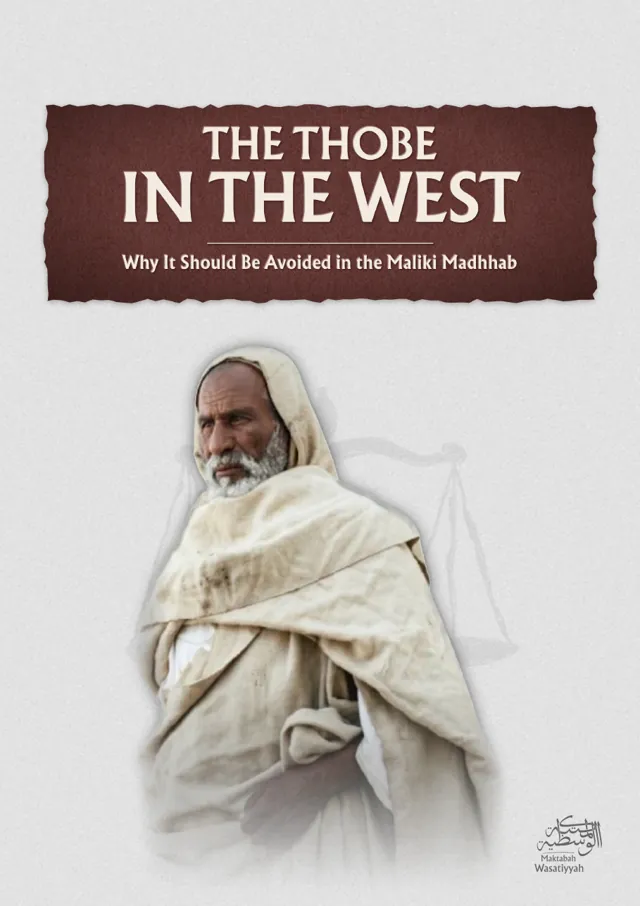
The Thobe in the West
Why It Should Be Avoided in the Maliki Madhhab
3 November 2026 · 16 footnotes · pp. 3–11 · 9 min
Introduction
In the Name of Allah, the Most Merciful, the Especially Merciful.
All praise is due to Allah, who perfected the religion, completed His favor upon His servants, and made this noble Shariah a light by which the hearts are guided and the affairs of creation are set aright. He sent His Messenger ﷺ with guidance and the religion of truth, to make it prevail over all ways, even if the corrupters dislike it. May abundant peace and blessings be upon him, his family, his companions, and those who follow their path with excellence until the Day of Judgment.
To proceed: many Muslims in Western countries wear the thobe, or other Arab dress, as their everyday clothing, out of love for the Sunnah and for the way of the righteous. Their intention is good. But the question is whether this is what the scholars of the Maliki school would advise for a man living among people who do not dress this way.
Others, however, wear it for other reasons: to look like the Arabs, to be taken for a student of knowledge or a scholar, or simply to stand out as more religious than those around them. This is exactly what the scholars warned against. Wearing a garment so that people see one as pious or learned is a form of shuhra, and the intention behind it is what makes it blameworthy.
This booklet gathers what the Maliki scholars said about libas al-shuhra, the dress of fame: clothing that makes a person conspicuous among his people. It begins with the hadith of the Prophet ﷺ on this and its authenticity, then explains what the scholars meant by shuhra, what its ruling is, and how they tied it to the custom of each land and time. It ends with what the scholars said about non-Arab Muslims and their own dress, and with a statement of Ibn Taymiyya on Muslims living among non-Muslims.
The ruling the Maliki scholars gave for shuhra in dress is that it is disliked (makruh), not forbidden. Nothing in this booklet should be taken as an attack on the thobe itself, which is a good and modest garment, nor on anyone who wears it. It is advice about what is best for a Muslim man in the West, taken from the words of the scholars, each traced to its source.
Written by, ʿAli ʿAbd Allah al-Maliki
Founder of Maktabah Wasatiyyah
Germany
23 Jumada al-Ula 1448 AH, corresponding to 03/11/2026
A – The Prophetic Warning
من لبس ثوب شهرة ألبسه الله يوم القيامة ثوبا مثله … ثم تلهب فيه النار
Whoever wears a garment of shuhra, Allah will clothe him on the Day of Resurrection in a garment like it … then fire will be kindled in it.1
— Sunan Abi Dawud, Hadith No. 4029
من لبس ثوب شهرة في الدنيا، ألبسه الله ثوب مذلة يوم القيامة، ثم ألهب فيه نارا
Whoever wears a garment of shuhra in this world, Allah will clothe him in a garment of humiliation on the Day of Resurrection, then kindle a fire in it.2
— Sunan Ibn Majah, Hadith No. 3607
The Prophet ﷺ ties the punishment to the garment itself: the one who sought to be seen in this world is made to be seen in humiliation on the Day of Resurrection. The warning is about the aim of standing out through one's clothing, not about any particular kind of cloth.
1. Its authenticity
The hadith is hasan (good). Al-Mundhiri said Ibn Majah narrated it "with a good chain", al-Albani graded it hasan, Shuayb al-Arnaut and his team called it a good hadith, and Ahmad Shakir went further and called its chain sound (sahih).345 Its narrators are reliable, apart from al-Muhajir ibn Amr, whom Ibn Hajar called acceptable and Ibn Hibban counted as reliable.6 A narration from Abu Dharr supports it.7
A hasan hadith is one whose narrators are trustworthy but slightly below the highest level of precision. The scholars of hadith and fiqh accept it as proof and act upon it, just as they act upon a sahih hadith. So this warning is established and is to be taken seriously.
B – What Libas al-Shuhra Is
والعالم يجتمع إليه الناس ويردون عليه، فيشرع له التجمل في الملبس دون أن يخرج عن عادة مثله. وكذلك العباد لا يستحسن لهم الخروج عن حسن الزي إلى الملبس الخشن لأن ذلك خروج عن العادة ومدخل فيما يشهره. وقد قال إبراهيم بن أدهم لرجل تنسك فلبس الصوف: رأيته تنسك نسكا أعجميا؛ فعاب ذلك عليه لخروجه عن عادة مثله
The scholar, to whom people gather and come, is legislated to beautify himself in his clothing without departing from the custom of people like him. Likewise, it is not approved for worshippers to leave good dress for rough clothing, because that is a departure from custom and a way into what makes a person conspicuous. Ibrahim ibn Adham said of a man who took up devotion and put on wool: "I saw him take up a foreign kind of devotion," and he faulted him for it because he departed from the custom of people like him.8
— al-Baji, quoted by Ibn Shas
This is the meaning of libas al-shuhra: clothing that departs from the custom of people like oneself, so that one becomes conspicuous by it. It is not about the cloth or the cut of a garment, but about how it stands among the people one lives with. Ibrahim ibn Adham called the wool-wearer's devotion "foreign" because it was not the way of his own people, even though his aim was worship.
في الجواهر: لا يلبس القباء الحسن لأنه شهرة
In al-Jawahir: one does not wear the fine qaba [a long outer coat], because it is shuhra.9
— al-Qarafi, al-Dhakhira
So shuhra is not only in rough or shabby clothing. A fine and respectable garment is also shuhra if it makes its wearer stand out from those around him.
C – The Ruling in the Maliki School
وقال مالك في لباس هذا الصوف الغليظ: لا خير في الشهرة، ولو كان المرء يلبس ذلك مرة ويطرحه أخرى إذا رجوت ألا يكون به بأس، فأما أن يعاهد عليه حتى يعرف ويشهر فإني أكرهه ولا أحبه. ومن ثياب القطن ما هو أخشن في اللباس وأبعد في الشهرة ومن رخص الثمن في مثل نصف ثمن هذا الصوف، فلا أحب ذلك ولا أستحسنه … قال محمد بن رشد: الشهرة في اللباس مذموم مكروه، والاقتصاد في ذلك هو المختار والمستحب
Malik said about wearing this coarse wool: "There is no good in shuhra. If a person wore it at one time and put it aside at another, I would hope there is no harm in it. But to keep to it constantly until he becomes known and conspicuous by it, that I dislike and do not like. There are cotton garments that are rougher to wear and further from shuhra, and as cheap as half the price of this wool. So I do not like that, nor do I approve of it." … Muhammad ibn Rushd said: "Shuhra in dress is blameworthy and disliked, and moderation in it is what is preferred and recommended."10
— Ibn Rushd al-Jadd, al-Bayan wa-l-Tahsil
The coarse wool Malik speaks of was not the ordinary dress of the people. It was associated with ascetics and worshippers, as in the words of Ibrahim ibn Adham above, and wearing it marked a man out from those around him. That is why Malik points out that there were cotton garments that were even rougher and cheaper, yet further from shuhra: the problem was not the roughness or the price, but that the wool made its wearer conspicuous.
Malik did not forbid the wool outright. He disliked keeping to it until one is known by it, and hoped there was no harm in wearing it at times. Ibn Rushd then gives the ruling plainly: shuhra in dress is disliked (makruh), and the middle way is what is recommended.
وإنما كره العلماء لباس الشهرة والإفراط في البذاذة والإسراف والغلو.
What the scholars disliked is only the dress of shuhra, excessive shabbiness, extravagance and going to extremes.11
— Ibn al-Arabi, al-Masalik fi Sharh Muwatta Malik
Ibn al-Arabi puts shuhra alongside extravagance and going to extremes. All of them are a departure from the middle way in dress, which is what the scholars of the school recommended.
D – Custom Decides
فيه مخالفتهم السنة في ترك التحليق، وكراهة التحليق للتشبه بهم، إلا في البلاد التي صارت عادتهم التحليق، وأن ترك الشعر شهرة.
In it is [evidence] that they went against the Sunnah of leaving the hair unshaved, and that shaving is disliked because it resembles them, except in lands whose custom has become shaving, and where leaving the hair is shuhra.12
— al-Qadi Iyad, Ikmal al-Mulim
Al-Qadi Iyad shows that even what follows the Sunnah in one land can become shuhra in another, when the custom of its people is different. If this is said about leaving the hair, which is a Sunnah, then it applies all the more to a garment, which is a matter of custom.
قال مالك: ليس الصوف من لباسهن ولكن يحكم بما يرى أنه من لباسها، والذي ذكره ابن حبيب من الفرو والقميص عليه إنما ذلك لأنه كان زي بلده في ذلك الوقت، وإنما يتبع في ذلك زي الناس في وقت الحكم
Malik said: "Wool is not their clothing; rather the ruling is given according to what is seen to be her clothing." What Ibn Habib mentioned, the fur with the qamis over it, was only because it was the dress of his land at that time. In this, one follows the dress of the people at the time of the ruling.13
— al-Baji, al-Muntaqa
This passage is about the clothing a husband must provide for his wife, but it shows the principle clearly: what counts as normal dress is set by the place and the time.
والثاني: أنه شهرة وليس من لباس أهل المروءة في زماننا هذا، وإن كان قد كان لباس كثير من أهل الفضل والذين قبلنا، فالذي ينبغي للرجل أن يتزيا في كل زمان بزي أهله ما لم يكن إثما، لأن مخالفة الناس في زيهم ضرب من الشهرة
The second [reason]: it is shuhra and is not the dress of people of propriety in this time of ours, even though it was the dress of many people of virtue before us. So what a man should do is dress, in every age, in the dress of its people, as long as it is not sinful, because going against people in their dress is a kind of shuhra.14
— al-Tabari, quoted by Ibn Battal
These are the words of al-Tabari, which Ibn Battal transmits in his commentary on al-Bukhari without objecting to them. A garment worn by the righteous in one age can become shuhra in another, when it is no longer the dress of its people. The condition al-Tabari adds, "as long as it is not sinful", matters: following the dress of one's people never means wearing what is immodest or forbidden.
E – Arab Dress Is Not Required
واستخف ابن رشد تلثم المرابطين، لأنه زيهم به عرفوا، وهم حماة الدين … ونحوه نقل البرزلي عن بعض شيوخه أن رسول الله صلى الله عليه وسلم إنما نهى العرب أن يتشبهوا بالعجم ولم يأت أنه نهى وفدا قدموا عليه من وفود الأعاجم أن ينتقلوا عن زيهم إلى زي العرب، والمراد بهذا النهي التشبه بالعجم فيما فعلوه على خلاف مقتضى شرعنا، وأما ما فعلوه على وفق الندب، أو الإيجاب، أو الإباحة في شرعنا فلا يترك لأجل تعاطيهم إياه
Ibn Rushd regarded the litham of the Murabitun as a light matter, because it is their dress by which they are known, and they are the protectors of the religion … Similar is what al-Burzuli reported from one of his teachers: the Messenger of Allah ﷺ only forbade the Arabs from imitating the non-Arabs; it is not reported that he forbade any of the non-Arab delegations that came to him from keeping their dress, or told them to change to the dress of the Arabs. What is meant by this prohibition is imitating the non-Arabs in what they do contrary to what our Sharia requires. As for what they do in line with what our Sharia recommends, obliges or permits, it is not abandoned because they practise it.15
— al-Mawwaq, al-Taj wa-l-Iklil
A Muslim's own dress, when it is modest and free of anything forbidden, is not the imitation the Sharia forbids. The Prophet ﷺ did not ask the non-Arabs who accepted Islam to give up their dress for the dress of the Arabs. So a Muslim in the West who wears the modest clothing of his own people is not falling short of the Sunnah by doing so.
F – Ibn Taymiyya on Living Among Non-Muslims
ومثل ذلك اليوم: لو أن المسلم بدار حرب، أو دار كفر غير حرب؛ لم يكن مأمورا بالمخالفة لهم في الهدي الظاهر، لما عليه في ذلك من الضرر، بل قد يستحب للرجل، أو يجب عليه، أن يشاركهم أحيانا في هديهم الظاهر، إذا كان في ذلك مصلحة دينية: من دعوتهم إلى الدين، والاطلاع على باطن أمرهم لإخبار المسلمين بذلك، أو دفع ضررهم عن المسلمين، ونحو ذلك من المقاصد الصالحة. فأما في دار الإسلام والهجرة، التي أعز الله فيها دينه، وجعل على الكافرين بها الصغار والجزية، ففيها شرعت المخالفة. وإذا ظهر أن الموافقة والمخالفة لهم تختلف باختلاف الزمان والمكان؛ ظهرت حقيقة الأحاديث في هذا.
Similar to that today: if a Muslim is in a land of war, or a land of disbelief that is not at war, he is not commanded to differ from them in outward appearance, because of the harm that would come to him from it. Rather, it may be recommended for a man, or even obligatory on him, to share in their outward appearance at times, if there is a religious benefit in it, such as calling them to the religion, learning their inner affairs in order to inform the Muslims of them, or warding off their harm from the Muslims, and similar sound aims. As for the land of Islam and Hijra, in which Allah has made His religion mighty and placed submission and the jizya upon the disbelievers, it is there that differing [from them] was legislated. And once it is clear that agreeing with them and differing from them varies with the difference of time and place, the true meaning of the hadiths on this becomes clear.16
— Ibn Taymiyya, Iqtida al-Sirat al-Mustaqim
Ibn Taymiyya was not a Maliki, but his words agree with what the Maliki scholars said: the outward appearance of a Muslim living among non-Muslims is not judged as it is in a Muslim land. Where standing out brings harm, or turns people away from the religion, the Muslim is not asked to set himself apart by his dress.
In Sum
- The Prophet ﷺ warned against the garment of shuhra, in a hadith graded hasan.
- Libas al-shuhra is clothing that departs from the custom of people like oneself, so that one becomes conspicuous by it, whether it is rough or fine.
- Its ruling in the Maliki school is that it is disliked (makruh), not forbidden.
- What is normal dress is set by the custom of each land and time, and non-Arab Muslims were never required to adopt the dress of the Arabs.
- So wearing the thobe as everyday dress in the West, where it makes a man stand out, should be avoided. Wearing it at times, such as at the mosque, on Jumua and on Eid, is outside this, as Malik said: "If a person wore it at one time and put it aside at another, I would hope there is no harm in it."
And Allah is the One who truly has the Knowledge
and may Allah send His blessings on Muhammad
and his family and companions.
[End of Booklet]
Sources for Further Reading
Hadith Collections
- Abu Dawud, Sunan Abi Dawud. Ed. al-Maktaba al-Asriyya. No. 4029, 4/43: shamela.ws/book/1726/5566
- Ibn Majah, Sunan Ibn Majah. Ed. Dar Ihya al-Kutub al-Arabiyya. No. 3606, 2/1192: shamela.ws/book/1198/4985; No. 3607, 2/1192: shamela.ws/book/1198/4986; No. 3608, 2/1193: shamela.ws/book/1198/4987
Hadith Gradings
- Ahmad ibn Hanbal, al-Musnad, with the notes of Ahmad Shakir. Ed. Dar al-Hadith. No. 5664, 5/170: shamela.ws/book/98139/2405
- Ahmad ibn Hanbal, al-Musnad, with the notes of Shuayb al-Arnaut et al. Ed. Muassasat al-Risala. No. 5664, 9/476: shamela.ws/book/25794/4355; No. 6245, 10/363: shamela.ws/book/25794/4763
- Al-Albani, Sahih al-Targhib wa-l-Tarhib. Ed. Maktabat al-Maarif. 2/479: shamela.ws/book/171/1108; 2/480: shamela.ws/book/171/1109
- Al-Busiri, Misbah al-Zujaja fi Zawaid Ibn Majah. Ed. Dar al-Arabiyya. 4/90: shamela.ws/book/5635/611
- Ibn Hajar, Taqrib al-Tahdhib. Ed. Dar al-Rashid. p. 387: sha mela.ws/book/8609/313; p. 548: shamela.ws/book/8609/474
Maliki Works
- Ibn Battal, Sharh Sahih al-Bukhari. Ed. Maktabat al-Rushd. 9/122: shamela.ws/book/10486/4502; 9/123: shamela.ws/book/10486/4503
- Al-Baji, al-Muntaqa Sharh al-Muwatta. Ed. Matbaat al-Saada. 4/129: shamela.ws/book/6684/1163; 7/220: shamel a.ws/book/6684/2128
- Ibn Rushd al-Jadd, al-Bayan wa-l-Tahsil. Ed. Dar al-Gharb al-Islami. 18/431: shamela.ws/book/21751/8924; 18/432: sh amela.ws/book/21751/8925
- Ibn al-Arabi, al-Masalik fi Sharh Muwatta Malik. Ed. Dar al-Gharb al-Islami. 7/304: shamela.ws/book/123665/3610
- Al-Qadi Iyad, Ikmal al-Mulim bi-Fawaid Muslim. Ed. Dar al-Wafa. 3/611: shamela.ws/book/122406/1896
- Ibn Shas, Iqd al-Jawahir al-Thamina fi Madhhab Alim al-Madina. Ed. Dar al-Gharb al-Islami. 3/1288: shamela.ws/book/14594/1286; 3/1289: shamela.ws/book/14594/1287
- Al-Qarafi, al-Dhakhira. Ed. Dar al-Gharb al-Islami. 13/264: shamela.ws/book/1717/5217
- Al-Mawwaq, al-Taj wa-l-Iklil li-Mukhtasar Khalil. Ed. Dar al-Kutub al-Ilmiyya. 2/186: shamela.ws/book/21611/404
Other Works
- Ibn Taymiyya, Iqtida al-Sirat al-Mustaqim li-Mukhalafat Ashab al-Jahim. Ed. Dar Alam al-Kutub. 1/471: shamela.ws/book/11620/460; 1/472: shamela.ws/book/11620/461
This publication is a waqf, a charitable endowment made for the sake of Allah and for the benefit of all Muslims. It is not to be sold, traded, or used for worldly gain. Whoever wishes to print, copy, or distribute it free of charge may do so, provided that it is reproduced in full and without any alteration to the original text. Translations into other languages are permitted, provided that they are faithful to the original and name it as their source. First published in 2026. Published by Maktabah Wasatiyyah.